



Operating high-rate algal ponds as sequencing batch reactors: a novel approach to enhanced wastewater treatment
 *ab
Felipe
Sabatte,
ab
Harriet
Whiley,
ab
Enzo
Palombo,
bc
Melissa H.
Brown,
ab
Ngai Ning
Cheng,
d
Ben
Van Den Akker
e
and
Howard
Fallowfield
ab
*ab
Felipe
Sabatte,
ab
Harriet
Whiley,
ab
Enzo
Palombo,
bc
Melissa H.
Brown,
ab
Ngai Ning
Cheng,
d
Ben
Van Den Akker
e
and
Howard
Fallowfield
ab
Abstract
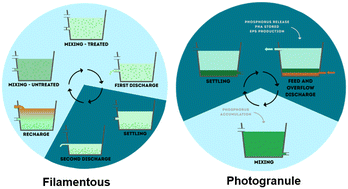
Effective wastewater treatment is critical for public health and environmental protection. In regional communities, where resources are limited, there is a need for sustainable and low-cost wastewater treatment solutions. Commonly used waste stabilisation ponds, have large land requirements, inconsistent treatment performance and high rates of evaporative water loss. High rate algal ponds (HRAPs) offer a smaller area footprint and consequentially reduced capital expenditure, enhanced treatment performance and a low maintenance alternative. HRAPs are commonly operated as continuously stirred tank reactors, at shallow depth (0.2–0.5 m) mixed by a paddlewheel. Effective wastewater treatment is then achieved by a consortium of naturally occurring, harmless microalgae and bacteria. However, there is a need to further improve their operation and the quality of the treated effluent to enhance water reuse opportunities and alleviate water insecurity concerns in rural communities. Here we uniquely propose two different operational strategies for HRAPs as the next step forward for this treatment technology. The two strategies require operation as sequencing batch reactors, which enables independent management, of hydraulic retention time and solids retention time, providing additional operational management strategies. Significantly, this offers the potential to develop influent feeding and mixing strategies to develop biofilm like assemblages of photogranules or to selectively enrich and maintain filamentous algal populations. The increased density of either photogranules or filamentous algae will enable efficient biosolids separation yielding an effluent low in suspended solids. The biomass separation may also be achieved within the HRAP avoiding the need to construct and manage additional infrastructure. The enhanced treated effluent quality increases opportunities for added value beneficial water reuse in climate change related water stressed communities. Future research is needed to validate this approach and the optimum operating conditions to achieve treatment and efficient in situ biomass separation.
- This article is part of the themed collections: HOT articles from Environmental Science: Water Research & Technology and REV articles from Environmental Science: Water Research & Technology
 Please wait while we load your content...


