


 PLATFORM UPDATE:


Techno-economic and life cycle assessment of an integrated electrocoagulation process for sustainable treatment of arsenic and fluoride contaminated groundwater
 a
and
a
and
Abstract
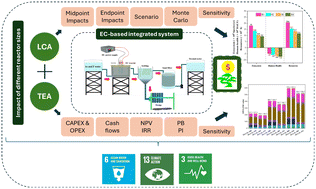
The present study evaluated the environmental and economic sustainability of an electrocoagulation-based system for arsenic and fluoride removal through life cycle analysis (LCA) and techno-economic assessment (TEA). The impact of different treatment capacities of the EC process has been evaluated. With the increase in scaling up the EC system from lab-scale (1.7 L) to large-scale (650 L), a reduction in environmental footprints across all ReCiPe midpoint categories (e.g. global warming potential (GWP) 5.38 to 2.63 kg CO2 eq. (51%)) has been observed. Further, endpoint analysis indicated significant damage to the ecosystem (9.3 × 10⁻⁹ species per year) and resources ($0116). Interestingly, the negative endpoint human health impact values (−7.3 × 10⁻⁶ disability adjusted life years (DALY) for large-scale operation) suggest potential health benefits from treated water. Sensitivity and Monte Carlo analyses confirmed the robustness and reliability of the results, while utilizing carbon free electricity sources further reduced the impacts (GWP 36.7% less for solar). TEA analysis confirms the profitability of the EC treatment process since the net present value (NPV), internal rate of return (IRR), payback period (PB) and profitability index (PI) of the best scenario (3 shift operation with sludge utilization) are as INR 450.7 Lakhs ($0.51 million), 49.3%, 2.17 years and 1.85, respectively. Utilizing solar energy increases the capital expenditure (CAPEX) of the process by 64.2% but reduces the operational expenditure (OPEX) by 11.4%. Despite the higher initial investment for the use of solar energy, the overall scenario remains economically profitable. Overall, the integration of LCA and TEA highlights the feasibility of scaling up the electrocoagulation process as a sustainable and cost-effective solution for real-world applications.
 Please wait while we load your content...


