


Optical properties, oxidative potential and chemical composition of brown carbon in the megacity Shenyang of Northeast China
 *a
*a
Abstract
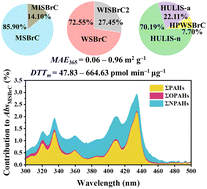
Brown carbon (BrC) plays a crucial role in altering radiative forcing and impacting human health. However, comprehensive knowledge of BrC in megacities remains limited. This study systematically examined the optical properties, oxidative potential (OP) and chemical composition of BrC in the megacity Shenyang of Northeast China. Methanol-soluble BrC (MSBrC) and humic-like substances (HULIS) were the most important components of total BrC and water-soluble BrC (WSBrC), respectively. For different BrC fractions, the mass absorption efficiency at 365 nm (MAE365) varied in the range of 0.16–0.96 m2 g−1, and the absorption Ångström exponent (AAE) ranged from 4.25 to 12.10, which were dependent on the chemical composition of BrC. The contribution of polycyclic aromatic hydrocarbons (PAHs) and their derivatives to the MSBrC light absorption was up to 2.93%. Water-insoluble BrC (WISBrC) showed a relatively higher OP value, which can be largely related to the content of C–H groups with strong electron transfer capacity.
 Please wait while we load your content...


