


Mechanistic insights into extracellular reductive dechlorination of hexachloroethane by common non-electroactive bacteria Bacillus subtilis and Escherichia coli

Abstract
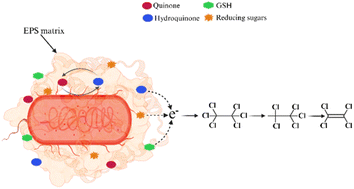
Extracellular reductive dechlorination of chlorinated aliphatic hydrocarbons (CAHs) by non-electroactive bacteria is rarely investigated. In this study, we demonstrated that common bacteria Gram-positive Bacillus subtilis (B. subtilis) and Gram-negative Escherichia coli (E. coli) in aqueous suspensions (1.2 × 10⁸ cells per mL) could dechlorinate a model CAH compound hexachloroethane (HCE, initial 40 µmol L−1) at ratios of 83.7% and 54.1% respectively to pentachloroethane (PCE) and tetrachloroethylene (TCE) after 56 h incubation at pH 7.0 and 30 °C. The majority of the parent compound (HCE) and reaction products (PCE and TCE) present in the extracellular matrix indicated the predominance of extracellular reduction. Removing EPS from bacteria suppressed HCE reduction, while adding extra dissolved EPS slightly enhanced HCE reduction. The enhanced reduction of HCE by low-molecular-weight EPS (<3 kDa) relative to bulk EPS of B. subtilis and its counterpart high-molecular-weight EPS (>3 kDa) indicated that low-molecular-weight EPS were more enriched in active reducing agents. Additionally, dechlorination of HCE by electrochemically reduced glutathione and disodium anthraquinone-2,6-disulfonate or juglone suggested that thiol groups and quinones were involved as reducing agents and electron mediators, respectively. These findings underscore a previously unknown process of extracellular reductive dechlorination of CAHs by common non-electroactive bacteria and the key role played by EPS.
- This article is part of the themed collection: HOT articles from Environmental Science: Processes & Impacts
 Please wait while we load your content...


