


 PLATFORM UPDATE:


A new perspective for research on the mechanism and kinetic model of aggregation between coastal spilled oil and suspended sediment
 *b
*b
Abstract
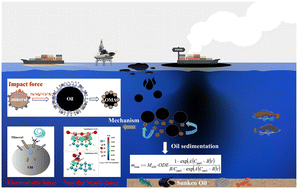
Understanding oil spill behavior in estuarine and coastal systems requires knowledge of oil–mineral aggregate (OMA) formation, as this process significantly governs the transport of floating oil. Current understanding of OMA formation remains superficial, lacking in-depth analysis of underlying micromechanisms. Moreover, existing models rely solely on mineral concentration, resulting in limited applicability. In this study, the aggregation between moderately dispersed oil and various minerals was investigated through mesoscale simulation experiments conducted in a wave tank. Physicochemical and morphological analyses confirmed the van der Waals, electrostatic, and impact forces between oil droplets and minerals. Their relative contributions under varying conditions were qualitatively assessed. Furthermore, a new oil-attenuation equation under particle intervention was proposed, and the coupling of the oil spill dispersion model and the OMA density prediction model was achieved. Based on the experimental data, the expression of the integrative coefficient (α) in relation to the key characteristics of minerals was derived. The new model can accurately predict the time-dependent oil sedimentation at high mineral concentrations. These results can offer technical support for maritime management and marine environmental protection departments to quantitatively evaluate the settlement degree and hazard scope of coastal oil spills.
 Please wait while we load your content...


