


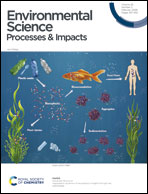
Unraveling the contamination, source and health risk of per- and polyfluoroalkyl substances in PM2.5 during winter from a southwestern city in China
 *a
*a
Abstract
A total of 44 PM2.5 samples were collected intermittently over three winter months (December 2021–February 2022) in the urban center of Chongqing, a city in southwestern China, and analyzed for per- and polyfluoroalkyl substances (PFAS, 20 species). The concentrations and compositions of the PFAS were analyzed by HPLC-MS/MS to determine their sources and potential human health risk. The PFAS concentrations ranged from 70.3 pg m−3 to 404.9 pg m−3, with an average of 197.1 ± 73.7 pg m−3. Monthly variations were as follows: January (281.9 pg m−3) > February (160.6 pg m−3) > December (148.7 pg m−3). The PFAS were dominated by perfluorobutanoic acid (PFBA), perfluorooctanoic acid (PFOA), perfluorohexanoic acid (PFHxA), and 2-perfluorohexyl ethanoic acid (6:2 FTCA). Positive Matrix Factorization (PMF) identified aqueous film-forming foam (AFFF) (43.2%) and precursor degradation (38.3%) as the main sources, followed by lifestyle-related pollution (18.5%). Median Estimated Daily Intake (EDI) for children (age-stratified: 0–6, 6–12, 12–15, 15–18 years) and adults for PFOA (7.69 pg per kg per day) and perfluorooctane sulfonate (PFOS) (0.52 pg per kg per day) was substantially below the U.S. EPA reference dosage (20 000 pg per kg per day). The Hazard Quotient (HQ) was far lower than 1, indicating negligible inhalation-related risk. The results of these two models both implied acceptable PFAS exposure levels. However, prolonged cumulative exposure via PM2.5-bound PFAS inhalation warrants greater attention due to their lifelong health implications.

 Please wait while we load your content...


