


In situ surface matrix solidification of FAPbI3 perovskite quantum dots for solar cells with 19.37% efficiency
 *a
and
Xiaoliang
Zhang
*a
*a
and
Xiaoliang
Zhang
*a
Abstract
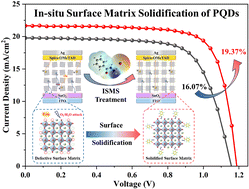
Formamidinium lead triiodide perovskite quantum dots (FAPbI3 PQDs) attract remarkable attention for new generation photovoltaics owing to their outstanding optoelectronic properties and solution processability. However, the surface matrix of PQDs generally suffers from surface ligand detachment induced by the antisolvents during the purification process, eventually leading to the formation of numerous surface vacancies and thus seriously degrading the optoelectronic properties and stability of PQDs. Herein, a facile in situ surface matrix solidification (ISMS) strategy is reported to renovate the defective surface matrix of PQDs for efficient solar cells. During the ISMS, the multifunctional ligand benzoylhydrazine (BHZ) could react with I2 to generate benzoylhydrazine hydroiodide (BZI) in the antisolvent, which could compensate for FA+ and I− vacancies at the surface matrix of PQDs, thereby substantially suppressing nonradiative recombination induced by the surface defects of PQDs. Meanwhile, the protonated benzoylhydrazine cations of BZI and BHZ ligands could also anchor on the PQD surface to solidify the surface lattice of PQDs, largely improving the structural stability of PQDs. Consequently, the PQD solar cells achieve a power conversion efficiency of up to 19.37%. This work provides important insight and design principles for the surface matrix regulation of PQDs using surface chemistry for achieving high-performance optoelectronic devices.
- This article is part of the themed collection: Celebrating Nam-Gyu Park’s 65th birthday
 Please wait while we load your content...


