


Synergistic steric–dipole modulation via stepwise trifluoromethyl substitution enables active-layer hierarchical assembly and >20% power conversion efficiency in organic photovoltaic devices

Abstract
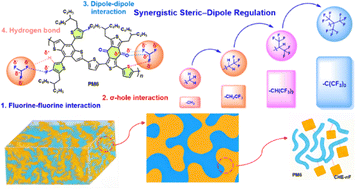
Rational molecular design can effectively optimize the fineness of phase separation and vertical phase gradients of organic solar cells (OSCs), thereby boosting exciton dissociation kinetics and device efficiency. The “Cδ+–Fδ−” polarity of –CF3 promotes diverse noncovalent interactions, providing a key driving force for ordered assembly of active layer morphology. Herein, three acceptors (named CHE-nF n = 3, 6, 9) were synthesized by stepwise –CF3 functionalization of CHE-Me, progressively enhancing steric and molecular dipole effects, while continuously reducing surface energy. Research indicates that increased steric hindrance suppresses acceptor over-aggregation, thereby optimizing domain size. Enhanced dipoles strengthen donor/acceptor (D/A) interactions, shorten π–π stacking distances, accelerate exciton dissociation, and mitigate trap-assisted recombination; while minimized surface energy induces vertical phase gradients that facilitate charge transport. The steric–dipole–surface energy synergistic regulation strategy yielded an optimized morphology, delivering a power conversion efficiency (PCE) of 19.32% (fill factor (FF) of 82.06%) for the CHE-9F device, 20.30% for the ternary device, and 16.69% for the module. This work establishes a molecular steric–dipole regulation strategy for the precise control of phase separation and vertical composition gradients in photoactive layers, providing an effective pathway for high-performance OSCs.
 Please wait while we load your content...


