An Electric Double-layer Capacitor with High Performance at -80 °C

Abstract

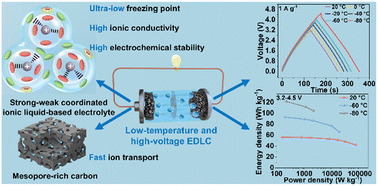
Electric double-layer capacitors (EDLCs) with a high energy density for ultralow-temperature use are crucial for polar and space explorations, but hindered by the lack of suitable electrolytes and electrodes. We proposed a strong-weak interaction strategy to precisely regulate the solvation structure of an ionic liquid-based electrolyte that is stable from 25 to -80 °C.Then by using activated carbon with a mesopore-rich structure, we obtain an EDLC that can be used at -80 °C and 4.5 V, and has a record energy density of 104.5 Wh kg -1 with an 89.5% capacitance retention after 10,000 cycles. Furthermore, a 300 F pouch-type EDLC was assembled and it can operate stably from 25 to -80 °C, demonstrating the practical applicability. This study provides strategic guidance for constructing EDLCs with a high energy density for use under extreme conditions.
Supplementary files

Transparent peer review

To support increased transparency, we offer authors the option to publish the peer review history alongside their article.

View this article’s peer review history

Article information

Article type
Paper
Submitted
12 Nov 2025
Accepted
24 Mar 2026
First published
26 Mar 2026

Energy Environ. Sci., 2026, Accepted Manuscript

An Electric Double-layer Capacitor with High Performance at -80 °C

H. Liu, F. Zhou, Z. Zhang, H. Wang, H. Liu, Z. Ren, E. Yang, Z. Ma, T. Chen, P. Das, C. Ma, A. Leng, S. Liao, X. Zhang, Y. An, C. Lian, Y. Ma, H. Cheng and Z. Wu, Energy Environ. Sci., 2026, Accepted Manuscript , DOI: 10.1039/D5EE06850A

To request permission to reproduce material from this article, please go to the Copyright Clearance Center request page.

If you are an author contributing to an RSC publication, you do not need to request permission provided correct acknowledgement is given.

If you are the author of this article, you do not need to request permission to reproduce figures and diagrams provided correct acknowledgement is given. If you want to reproduce the whole article in a third-party publication (excluding your thesis/dissertation for which permission is not required) please go to the Copyright Clearance Center request page.

Read more about how to correctly acknowledge RSC content.

Social activity

Spotlight

Advertisements