


 PLATFORM UPDATE:

Thermodynamic inhibition of bromine-rich phase nucleation in wide-bandgap perovskites for operationally stable tandem solar cells
 *d
Zhaojin
Wang,
ab
Xinyu
Ye,
a
Yuanmiao
Sun,
a
Aung Ko Ko
Kyaw,
f
Hanlin
Hu,
e
Xinbo
Yang,
*c
Xiaohong
Zhang,
*c
Gang
Li,
d
Yang
Bai
*abgj
and
*d
Zhaojin
Wang,
ab
Xinyu
Ye,
a
Yuanmiao
Sun,
a
Aung Ko Ko
Kyaw,
f
Hanlin
Hu,
e
Xinbo
Yang,
*c
Xiaohong
Zhang,
*c
Gang
Li,
d
Yang
Bai
*abgj
and
Abstract
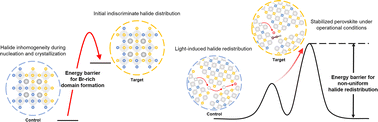
Operational instability in wide-bandgap (WBG) perovskites, predominantly caused by light-induced halide phase segregation, remains a major obstacle to the commercialization of perovskite-based tandem solar cells. Current strategies focus on mitigating the consequences of halide migration rather than targeting its fundamental origin. In this study, we reveal that the preferential nucleation of bromine-rich phases during film formation initiates intrinsic compositional inhomogeneity, which subsequently accelerates halide migration and phase segregation under operational stressors. We develop a preemptive inhibition strategy by introducing potassium thiocyanate, which suppresses halide segregation by raising the nucleation energy barrier of bromine-rich phases from the outset, thereby achieving a thermodynamically stabilized halide distribution. This approach enables 1.68 eV single-junction devices to achieve a high power conversion efficiency of 23.50%, with the devices simultaneously demonstrating excellent stability by maintaining 98% of their initial efficiency over 2240 hours of continuous maximum power point tracking. Leveraging this stable absorber, we realize a perovskite-silicon tandem solar cell with a remarkable efficiency of 33.08% (certified 32.52%), which retains its performance over 540 hours of outdoor operation and achieves an extrapolated T90 lifetime exceeding 9700 hours under continuous maximum power point tracking. Furthermore, we demonstrate the broad applicability of this stabilization strategy across WBG perovskites. The 1.68–1.88 eV compositions show exceptional spectral stability with negligible photoluminescence shifts under identical stress conditions, enabling efficient single-junction devices with efficiencies of 20.37% (1.77 eV) and 18.11% (1.88 eV), as well as high-performance all-perovskite (28.18%, certified 28.17%) and perovskite-organic (25.66%) tandem solar cells.
 Please wait while we load your content...


