


Superior high-temperature electrostatic energy storage in flexible dielectric films enabled by metal-coordination crosslinked networks

Abstract
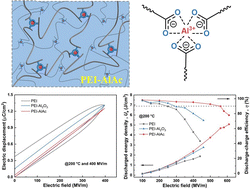
Flexible dielectrics for high-temperature electrostatic energy storage suffer from poor thermal stability, low insulation strength and inferior charge–discharge performances at elevated temperatures and high electric fields. Constructing a crosslinked structure in flexible dielectrics has been proven to be an effective strategy to enhance the thermal and insulation properties. Nevertheless, the crosslinking centers in traditional crosslinked networks are electrically neutral, and they are chemically or physically inert toward thermally excited electrons. The lack of a strong interaction between charge carriers and host dielectrics would lead to the formation of a severe conduction loss and reduction in breakdown strength at elevated temperatures, ultimately leading to an inferior electrostatic charge–discharge performance. Moreover, the traditional crosslinked polymer dielectrics are based on an irreversible covalent bond rather than a reversible interaction, and their waste becomes a significant environmental burden. Herein, we construct a metal-coordination crosslinked network in polymer dielectrics via using metal ions as crosslinking points. The metal ions exhibit strong affinity for electrons and accordingly can act as deep traps to capture the energetic electrons. Moreover, the dense crosslinked network can reduce the free volume and increase the mechanical strength, consequently contributing to the improvement of thermal stability and electrical insulation performances. The resultant film exhibits a superior electrostatic energy storage performance with a discharged energy density of 4.68 J cm−3 above 90% charge–discharge efficiency at 200 °C, which increases by more than 5 times compared to that of the pristine film. Additionally, this type of network can be dynamically dissociated and reformed under acidic conditions, thereby contributing to the recycling of dielectrics. The recycled sample also displays a good electrostatic energy storage performance. This strategy not only strengthens the interaction between charge carriers and host dielectrics but also solves the poor recyclability of traditional crosslinked flexible dielectrics. These findings offer an effective approach for designing high-performance and environmentally friendly flexible dielectrics.
 Please wait while we load your content...


