


A high-energy asynchronously reverse dual-ion battery based on H−/Na+ insertion chemistry

Abstract
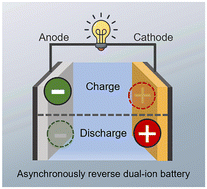
The ever-increasing demand for high-energy rechargeable batteries drives global innovation in new battery chemistry and device design. Here, we propose an asynchronously reverse dual-ion battery (ARDIB) operating with a non-traditional charge storage paradigm that fundamentally differs from existing battery technologies. In this battery, anions and cations are respectively inserted into anode and cathode via an asynchronous process, which was made possible by coupling an insertion-type MnO2 cathode to accommodate sodium ions (Na+) during discharging and a conversion-insertion-type Mg–Y alloy anode for storing hydride ions (H−) during charging. This H−–Na+ ARDIB benefits from an aqueous electrolyte containing tetramethylammonium hydroxide (TMAOH), which triggers microstructural reconstruction of the thick MnO2 cathode and supports the reversible alloy-hydride conversion of the anode. As a planar micro-battery, the ARDIB delivers a high areal capacity of 0.43 mAh cm−2 and an energy density of 0.42 mWh cm−2 at 1 mA cm−2, maintains stable operation for 5700 cycles at 10 mA cm−2 and exhibits superior rate capability with a maximum power density of 30.8 mW cm−2. These performance metrics surpass those of most reported micro-batteries and enable integration with miniature electronic devices and photovoltaic harvesting systems, providing a configuration-based solution for next-generation energy storage.
 Please wait while we load your content...


