


The interlayer proton capture and transport mechanism in oxygen electrodes boosts proton ceramic electrolysis

Abstract
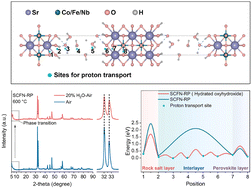
The synergistic regulation of steam utilization and proton transport at the oxygen electrode is crucial for proton ceramic electrolysis cells (PCECs). Ruddlesden–Popper (RP) perovskites leverage interlayer water intercalation features to achieve rapid proton uptake even under low-steam conditions. Herein, an RP-type oxygen electrode capable of reversible phase transitions and hydrated oxyhydroxide formation under high-temperature steam was constructed, successfully transcending the hydration limits of single perovskites. By integrating the structural analysis employing microcrystal electron diffraction (MicroED) and density functional theory (DFT) calculations, it is revealed that the interlayer proton-trapping sites significantly boost the steam adsorption/hydration and lower the energy barrier for proton migration across layers. The Sr3(Co0.8Fe0.1Nb0.1)2O7−δ (SCFN-RP) electrode demonstrates excellent catalytic activity, reaching 1.01 A cm−2@1.3 V at 550 °C. This work emphasizes the crucial role of reversible hydrated oxyhydroxides in RP perovskites and offers a novel conception for the design of high-performance oxygen electrodes for PCECs.
 Please wait while we load your content...


