


 PLATFORM UPDATE:


Unlocking high alcohol product selectivity in methane-to-ethanol conversion at practically relevant current density via dual-site-driven cascade electrocatalysis
 ab
Dashuai
Wang,
b
Xianyun
Peng,
b
Zhongjian
Li,
ab
Qinghua
Zhang,
ab
Paolo
Samorì
e
and
Yang
Hou
*acd
ab
Dashuai
Wang,
b
Xianyun
Peng,
b
Zhongjian
Li,
ab
Qinghua
Zhang,
ab
Paolo
Samorì
e
and
Yang
Hou
*acd
Abstract
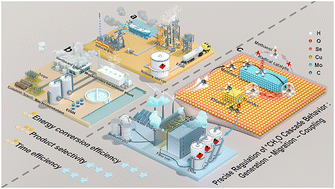
Electrochemical conversion of methane (CH4) is a sustainable route for converting greenhouse gases into valuable liquid fuels and chemicals. However, achieving high-yield products at industrially relevant current densities remains a formidable challenge. Here, we report a machine learning-guided Mo–Cu dual-site cascade catalytic strategy, enabling selective modulation of key *CH3O and achieving ethanol (EtOH) electrosynthesis. This system delivers a current density of 103 mA cm−2 with an EtOH faradaic efficiency of 55.8% ± 0.2%, establishing new performance benchmarks. Mechanistic and DFT analyses reveal that CH4 is activated by a three-electron *O2−-mediated oxidation pathway, while *CH3 spillover from Mo to Mo–Cu active sites facilitates exothermic C–C coupling, leading to high-efficiency EtOH production. Techno-economic analysis suggests that integrating renewable electricity can lower the CH4-to-EtOH production cost from $2.12 per kg to $1.50 per kg within a decade, offering a 53% energy return. This work establishes a cascade-regulated, dual-site framework for efficient CH4-to-EtOH conversion and offers a framework for machine learning-assisted catalyst design, contributing to cleaner energy technologies and substantial reductions in greenhouse gas emissions.
 Please wait while we load your content...


