


Blocking multifaceted degradation pathways via fluorinated hydrogen-bond armor for stable perovskite solar cells

Abstract
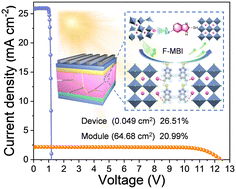
The long-term operational stability of perovskite solar cells (PSCs) is governed by a complex interplay of multiple coupled degradation mechanisms rather than isolated factors. Key processes including organic cation decomposition, halide anion oxidation, and ion migration do not occur independently but synergistically interact, ultimately leading to progressive lattice degradation and irreversible device failure. In this study, we propose a “fluorinated hydrogen-bond armor” strategy to comprehensively safeguard formamidinium cations (FA+) against deprotonation, shield iodide (I−) from oxidation, and suppress ion migration. 6-Fluoro-lH-benzimidazole-2-thiol (F-MBI) forms a stabilized complex with FA+ through hydrogen bonding. The strongly electronegative fluorine substituent induces local electronic redistribution via a hydrogen-bond-mediated electronic bridge, passivating proton-active sites and mitigating FA+ deprotonation. Simultaneously, the thiol (–SH) group in F-MBI acts as a reducing agent, protecting I from oxidative degradation. Moreover, F-MBI homogenizes the vertical concentration distribution of Cs+ and FA+ within the perovskite, eliminating the concentration gradient that drives ion migration. The F-MBI modified PSCs achieved an outstanding power conversion efficiency (PCE) of 26.51% (stabilized PCE of 25.85%) and retained over 90% of their initial efficiency after continuous maximum power point tracking (MPP) for 1950 hours under the ISOS-L-2 protocol. Furthermore, the incorporation of F-MBI into the fabrication of large-area modules (active area = 64.68 cm2) yielded an impressive PCE of 20.99%, highlighting the broad applicability and scalability. Our work lays a solid scientific foundation for the comprehensive enhancement of perovskite device photostability and the accelerated advancement toward commercialization.
 Please wait while we load your content...


