


 PLATFORM UPDATE:


Efficient solar-driven hydrogen peroxide production enabled by a perovskite electrochemical device integrated with a cobalt-based chiral catalyst
 †bc
Sang-Hoon
You,
b
Juwon
Lee,
e
Hyoung-il
Kim,
e
Yong-Tae
Kim,
b
Kug-Seung
Lee,
f
Donghwa
Lee,
bd
Jong Kyu
Kim
*b
and
Jooho
Moon
*a
†bc
Sang-Hoon
You,
b
Juwon
Lee,
e
Hyoung-il
Kim,
e
Yong-Tae
Kim,
b
Kug-Seung
Lee,
f
Donghwa
Lee,
bd
Jong Kyu
Kim
*b
and
Jooho
Moon
*a
Abstract
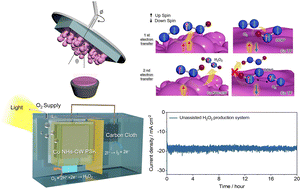
The solar-driven production of hydrogen peroxide (H2O2, a valuable energy carrier with excellent energy density and industrial applicability) using the two-electron oxygen reduction reaction (2e− ORR) represents a straightforward and eco-friendly technology. However, its efficiency is limited by the accumulation of oxygen intermediates (*OOH) adsorbed on the electrocatalyst, originating from spin-antiparallel electrons migrating through the latter, which hinders the favorable two-electron transfer to the triplet O2 possessing two spin-parallel electrons. Herein, we present Co metal-based nanohelices (Co NHs) with inherently chiral structures, synthesized via the oblique angle deposition method, as effective 2e− ORR catalysts based on their chirality-induced spin selectivity (CISS) effect. The chiral Co NH electrocatalyst, exhibiting a spin polarization efficiency of 78.1%, enhanced the 2e− ORR kinetics by facilitating the transfer of spin-parallel electrons and suppressing the accumulation of *OOH intermediates. Therefore, the Co NHs exhibited superior intrinsic 2e− ORR activity compared to achiral Co metal-based thin films, as confirmed by operando experiments and theoretical calculations. Subsequently, the Co NHs were integrated into a perovskite-based electrochemical device, and the resulting immersed perovskite-based cathode achieved a photocurrent density of −18.0 mA cm−2 at 1.2 V vs. reversible hydrogen electrode (VRHE), with a significant onset potential of 1.75 VRHE. Furthermore, we assembled an unbiased H2O2 production device using our immersed perovskite-based cathode paired with a carbon cloth for driving the iodide oxidation reaction; this device yielded a remarkable solar-to-chemical conversion efficiency of nearly 9.4%, with stable operation for 20 h.
 Please wait while we load your content...


