


 PLATFORM UPDATE:


β-Diketonate-bearing half-paddlewheel-type diruthenium(ii,ii) naphthyridine complexes with well-defined Ru–Ru double bonds

Abstract
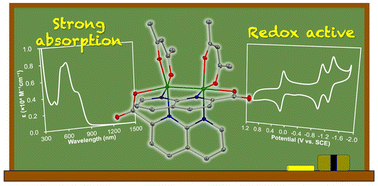
Three new diruthenium(II,II) naphthyridine complexes with β-diketonate ligands, [Ru2(npc)2(L)2] (npc = 1,8-naphthyridine-2-carboxylate, L = acetylacetonate (acac) for 2, hexafluoroacetylacetonate (hfac) for 3, and 1,3-diphenyl-1,3-propanedionate (dppd) for 4), were successfully synthesized via solvothermal reactions of [Ru2(npc)2(O2CMe)2] (1) with the corresponding β-diketone ligands. Crystallographic analyses revealed that 2–4 commonly adopt half-paddlewheel-type structures, which feature (i) a direct Ru–Ru double bond (2.3671(2), 2.3742(4), and 2.3587(5) Å, respectively), (ii) two npc ligands bridging the Ru2 core in head-to-tail fashion, and (iii) two β-diketonate ligands chelating each Ru ion. Temperature-dependent magnetic susceptibility measurements revealed that 2–4 exhibit effective magnetic moments of 2.85, 2.75, and 2.80μB at 300 K, respectively, which are consistent with the spin-only value of 2.83μB for an S = 1 system, and large zero-field splitting parameters (D = 235, 345, and 235 cm−1, respectively), which are commonly observed for paddlewheel-type Ru24+ complexes. Spin-density distributions and molecular orbital analyses based on density functional theory (DFT) calculations clarified that (a) two magnetic spins in 2–4 are predominantly localized on the Ru24+ core, (b) the electronic configuration of the Ru2 core is commonly π4δ2σ2δ*2π*2, and (c) the LUMO(β)s of 2 and 4 are mainly derived from the π*(npc) orbitals, whereas that of 3 is primarily composed of the π*(Ru2)/π*(hfac) orbital. Electrochemical properties are strongly influenced by the β-diketonate ligands; 3 exhibits a markedly positive shift of the oxidation wave attributed to the Ru25+/Ru24+ redox couple compared with 2 and 4, owing to the strong electron-withdrawing effect of the hfac ligand. Furthermore, a Ru24+/Ru23+ redox couple was observed for 3 at −0.37 V, whereas the corresponding reduction waves were not detected for 2 and 4. The absorption spectra of 2 and 4 exhibit intense bands in the 550–750 nm region, which are attributed to MLCT transitions from the Ru2 moiety to the npc ligands, and are similar to that of 1. In contrast, the absorption bands of 3 observed in the 502–630 nm region, which are significantly blue-shifted by 50–120 nm relative to those of 2 and 4 due to the strong electron-withdrawing effect of the CF3 group in the hfac ligand, were assigned to MLCT transitions from the Ru2 core to the npc ligands as well as the hfac ligands based on time-dependent DFT calculations.
 Please wait while we load your content...


