


Highly efficient heterogeneous water oxidation of a RuII disulfonic acid terpyridine complex on carbon nanotubes via π–π interactions
 *abc
*abc
Abstract
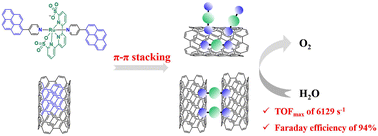
Water oxidation is essential for artificial photosynthesis that stores solar energy in chemical bonds. It is significantly challenging to immobilize homogeneous catalysts on solid surfaces while preserving their reactivity and stability. Appropriate methods for attaching transition-metal complexes onto a solid surface are highly desirable to drive water oxidation under a minimum overpotential and ambient conditions. Water oxidation catalyst Ru(tds)(L)2 (tds = 6,6″-disulfonic acid-[2,2′:6′,2″-terpyridine]; L = 4-(pyren-1-yl)pyridine) was prepared by ligand modification and anchored on multi-walled carbon nanotubes (MWCNTs) by π–π stacking interactions between the axial ligand with a large conjugated π plane and the sp2C–sp2C plane on the surface of the carbon nanotubes. The hybrid solid-state material, {Ru(tds)(L)2}@MWCNT, exhibited robust water oxidation performance, with a maximum turnover frequency (TOFmax) of 6129 s−1. Moreover, the faradaic efficiency for O2 production was calculated to be 94% within 1800 s of reaction.
 Please wait while we load your content...


