


Position-oriented N-methylation engineering: multidimensional regulation of energy-safety balance in energetic copper complexes

Abstract
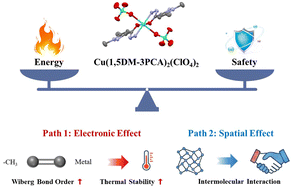
The development of green and insensitive primary explosives to replace toxic heavy-metal-based energetic materials (e.g., lead azide) remains a central challenge in the field of modern energetic materials. This work presents a ligand engineering strategy based on site-specific N-methylation to regulate the energy–safety balance in copper perchlorate energetic coordination compounds. By systematically employing four N-methyl-1H-pyrazole-carbohydrazide ligands with distinct methyl substitution patterns (varying in position and number), a series of isostructural congeners (ECC-1 to ECC-4) with identical coordination motifs are successfully constructed, providing ideal platforms for structure–property relationship studies. Multidimensional mechanistic investigations revealed that methylation exerts a finely tuned influence: ortho-methylation enhances thermal stability (e.g., ECC-4, Td = 188 °C), primarily by strengthening the coordination bonds through its electron-donating effect, while meta-methylation facilitates a more uniform molecular surface charge distribution, optimizing the supramolecular interaction network and thereby significantly improving mechanical safety. Owing to its balanced methylation pattern, the complex ECC-3 integrates low mechanical sensitivity (IS = 3.8 J, FS = 9 N), excellent laser ignition capability (El = 5 mJ), and reliable detonation performance, demonstrating the most promising overall practical potential among the studied energetic materials. This study elucidates the feasibility of synergistically tuning the properties of energetic materials at both molecular and supramolecular levels through rational ligand design, offering a new paradigm for developing high-performance and high-safety energetic materials.
 Please wait while we load your content...


