


 PLATFORM UPDATE:


Halogen-bonded self-assembly of mononuclear lanthanide(iii) complexes: variable temperature photoluminescence study and sensing of nitroaromatics
 a
Vishnu
Poonia,
b
Simran
Thakur,
c
Biswa Prakash
Nayak,
c
Hatem M.
Titi,
*d
Biswajit
Guchhait
*b
and
Ranjan
Patra
*a
a
Vishnu
Poonia,
b
Simran
Thakur,
c
Biswa Prakash
Nayak,
c
Hatem M.
Titi,
*d
Biswajit
Guchhait
*b
and
Ranjan
Patra
*a
Abstract
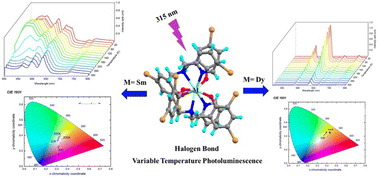
A series of lanthanide complexes, [LnL2][Et3NH]·H2O [where Ln = Dy (1), Sm (2) and Gd (3), [H2L = 2-bis(2-hydroxy-3,5-dibromo benzyl)aminomethyl]pyridine], have been synthesized and characterized through various spectroscopic techniques, including UV-Vis and infrared spectroscopy, mass spectrometry, and single-crystal X-ray diffraction. The supramolecular interactions of the complexes were analysed through a computational study. The photoluminescence properties of complexes 1 and 2 have been investigated, showcasing the characteristic colourful emissions perceivable by the human visual system (yellow and orange, respectively). The correlated colour temperature study shows that 1 is almost invariant, ranging from 3400 to 3500 K, whereas for 2, the values range from 7000 to 8000 K over the temperature range of 10–300 K. These emissive species are appropriate for the development of the colour point of white light and this could be useful for improvement of the brightness of display devices. Furthermore, the practical applicability of 1 was investigated as a fluorescent sensor for the sensitive detection of picric acid in a methanolic medium. Such complexes have potential applications in light-emitting devices and the sensing of molecular materials, and this research contributes to the growing interest in lanthanide-based materials for various technological applications, providing insights into their structural and photophysical properties.
 Please wait while we load your content...


