


Tetrazole-based energetic coordination compounds as enhanced catalysts for the thermal decomposition of ammonium perchlorate
 *bcd
Fa-Kun
Zheng
*ce
and
*bcd
Fa-Kun
Zheng
*ce
and
Abstract
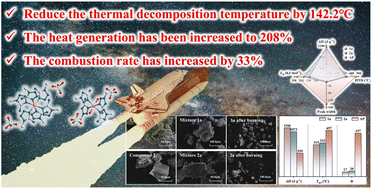
Unlocking the potential of ammonium perchlorate (AP) by achieving a highly synergistic, rapid, and concentrated energy release process is essential for realizing a revolutionary improvement in the thrust of composite solid propellants. In this study, we employ a strategy that integrates a simple solution synthesis method with highly active Co2+ ions, tetrazole-based high-energy ligands, and high-energy ClO4− anions to prepare energetic coordination compounds (ECCs): [Co(1-MAT)6](ClO4)21 and [Co(2-MAT)4(H2O)2](ClO4)22. This approach achieves a dual enhancement by improving the catalytic performance of AP and significantly increasing the total heat release (ΔH) of the system. Single-crystal X-ray diffraction revealed that both compounds possess isolated structures, which was further supported by elemental analysis and FT-IR spectroscopy results. The high-temperature decomposition (HTD) of 1a (5 wt% of 1 in AP) exhibits excellent energy-release performance, as evidenced by a decrease in the exothermic peak temperature from 457 °C (pure AP) to 315 °C. Moreover, compared to pure AP (230 kJ mol−1, 559 J g−1), the mixture 1a showed a lowered activation energy of 144 kJ mol−1 along with a concomitant rise in ΔH to 1166 J g−1. In contrast to the baseline without additives, the addition of Al/AP to combustion pellet-based 1 and 2 resulted in a significant increase in the burning rate. This distinctive structure represents a good strategy designed to simultaneously enhance both the energy output and catalytic efficiency of propellants.
 Please wait while we load your content...


