Single-Site Hydrogen-Bond Modulation Enhances Catalytic Ester Hydrolysis in a Zn(II)–TPA Scaffold

Abstract

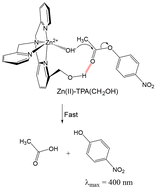
Zinc(II)-dependent metalloenzymes rely heavily on secondary-sphere interactions to modulate reactivity, inspiring the design of biomimetic Zn(II) catalysts that incorporate analogous features. Here, we introduce a hydroxymethyl-functionalized TPA ligand in which the pendant –CH₂OH group acts as a precisely positioned secondary-sphere hydrogen-bond donor that does not bind Zn(II) directly but reshapes the local microenvironment. This modification facilitates proton transfer, stabilizes the transition state, and enhances nucleophilic activation of the Zn–bound water molecule. Structural data support an intramolecular hydrogen-bonding network consistent with this mechanistic role. As a result, the engineered complex exhibits a dramatic rate enhancement—over an order of magnitude faster than the parent Zn(II)–TPA system—demonstrating the powerful catalytic impact of secondary-sphere engineering in artificial metalloenzymes.
Supplementary files

Transparent peer review

To support increased transparency, we offer authors the option to publish the peer review history alongside their article.

View this article’s peer review history

Article information

Article type
Paper
Submitted
22 Dec 2025
Accepted
20 Feb 2026
First published
27 Feb 2026

Dalton Trans., 2026, Accepted Manuscript

Single-Site Hydrogen-Bond Modulation Enhances Catalytic Ester Hydrolysis in a Zn(II)–TPA Scaffold

H. S. Kim and S. S. Lee, Dalton Trans., 2026, Accepted Manuscript , DOI: 10.1039/D5DT03058G

To request permission to reproduce material from this article, please go to the Copyright Clearance Center request page.

If you are an author contributing to an RSC publication, you do not need to request permission provided correct acknowledgement is given.

If you are the author of this article, you do not need to request permission to reproduce figures and diagrams provided correct acknowledgement is given. If you want to reproduce the whole article in a third-party publication (excluding your thesis/dissertation for which permission is not required) please go to the Copyright Clearance Center request page.

Read more about how to correctly acknowledge RSC content.

Social activity

Spotlight

Advertisements