


Surface interaction, polarity and probe mobility differences on organophosphonic-acid modified titania: a spin probe EPR study

Abstract
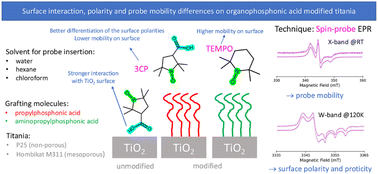
Many applications of organophosphonic-acid-grafted titania materials rely directly on their surface properties. Despite a manifold of studies on this type of material, limited information is currently available on the differences in (local) surface interactions induced by the grafting process. Here, multi-frequency spin-probe electron paramagnetic resonance (EPR) was used to probe these differences induced in a number of organophosphonic-acid-grafted titania. Two nitroxide spin probes (TEMPO and 3-carboxy-proxyl (3CP)) were adsorbed on the surfaces of unmodified, propylphosphonic acid (PPA)-modified and 3-aminopropylphosphonic acid (3APPA)-modified TiO2 P25 and TiO2 Hombikat M311. The 3APPA-modified titania adsorbed the most spin-probe molecules, while the PPA-modified titania adsorbed the least, highlighting the impact of the amine functional group. Also, the solvent plays a crucial role with the highest adsorption of spin probes obtained in heptane for TEMPO and in chloroform for 3CP. The EPR data showed clear differences in local polarity sensed by the 3CP and TEMPO when interacting with the different (un)modified titania, revealing the impact of surface Lewis-acid sites, hydroxyl surface interaction sites, type of organophosphonic acid and porosity. The 3CP probe allowed for a better differentiation of the surface polarities. The more polar environment perceived by the nitroxide moiety in the 3CP molecules adsorbed on the (un)modified Hombikat M311 surfaces is probably a result of the relatively higher portion of strong interactive sites compared to the (un)modified P25 surfaces and/or the curvature of the pore walls in Hombikat M311 materials. EPR also revealed clear differences in spin-probe mobility induced by the different surface properties.
 Please wait while we load your content...


