


Facile and low-cost construction of laser-ignitable energetic materials
 *bc
and
Qinghua
Zhang
*bc
*bc
and
Qinghua
Zhang
*bc
Abstract
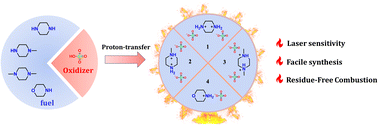
Laser ignition technology offers substantial improvements in safety, precision, and controllability compared to conventional ignition methods, establishing it as a promising next-generation platform. Although numerous energetic materials suitable for direct laser ignition have been reported, their practical implementation remains constrained by complex synthesis routes, high production costs, and problematic combustion residues. To address these limitations, four novel energetic compounds were developed through straightforward self-assembly of readily available piperazine-based organic fuels with perchloric acid. Remarkably, compound 1 exhibits exceptional thermal stability (Td = 366.6 °C) alongside superior detonation performance (7368 m s−1 and 22.6 GPa) that exceeds that of conventional TNT (6881 m s−1 and 19.5 GPa). All compounds demonstrate good laser-ignition characteristics with rapid response times (0.344–3.078 s), significantly outperforming traditional explosives such as RDX and HMX. Theoretical calculations performed using the NASA-CEA program revealed that partial replacement of ammonium perchlorate (AP) with these materials in propellant formulations yields specific impulse enhancements of 1.21–2.04 s at optimal mass ratios, indicating substantial performance improvements. The combination of complete residue-free combustion and enhanced performance in solid propellant formulations underscores the potential of piperazine-based architectures for advanced laser ignition systems.
 Please wait while we load your content...


