


A dynamically switchable three-layer terahertz metasurface based on a VO2–graphene hybrid for ultra-broadband and quad-narrowband absorption
 *b
*b
Abstract
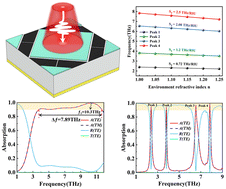
Versatile terahertz (THz) materials with multi-mode tuning capability are crucial for advanced terahertz communication systems. This research details a versatile THz absorber with twofold tunability, achieved by exploiting the phase-transition property of vanadium dioxide (VO2) and the electrical tunability of graphene. This absorber possesses the capability of real-time switching within the ultra-broadband absorption and four-frequency narrowband absorption, while also integrating the total reflection function. When VO2 is in the metallic state, the absorber achieves ultra-broadband absorption with absorptance exceeding 90% in the frequency range from 3.76 THz to 11.65 THz. When VO2 is in the insulating state and the Fermi level of graphene is tuned to 0.85 eV, the device exhibits four perfect narrowband absorption peaks with absorptance exceeding 90% in the THz band. The physical mechanisms under the two operating modes are thoroughly analyzed and verified using impedance matching theory, multiple interference reflection theory, and multipole analysis. Additionally, the perfect symmetry of the structure ensures the angular stability and polarization insensitivity of the device. Compared with traditional multi-layer design schemes, the proposed structure employs only a three-layer simple configuration, significantly reducing fabrication complexity while enabling multifunctional integration, thereby providing application potential in the fields of THz communication and sensing.
 Please wait while we load your content...


