


Cardanol biomass-derived hard carbon: a promising anode material for sodium-ion batteries
 b
Jing
Tang
*ac
b
Jing
Tang
*ac
Abstract
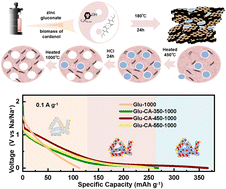
In this study, we proposed modifying zinc gluconate with cardanol to prepare hard carbon, the performance of which was improved compared with that of the existing hard carbon materials. After carbonization and acid etching, zinc gluconate and cardanol form a porous carbon structure with typical carbon layer crystallites. When preheated at 450 °C, cardanol and zinc gluconate were fully mixed to construct a hyper-crosslinked three-dimensional structure. At the same time, zinc oxide nanoparticles were formed and acted as a hard template to create nanopores in carbon frameworks during the subsequent etching step. The porous mesophase carbon was then further carbonized at 1000 °C to produce a typical hard carbon, which was named as Glu-CA-450-1000. Owing to suitable layer spacing and abundant closed nanopores, Glu-CA-450-1000 exhibits excellent electrochemical performance, with an initial coulombic efficiency (ICE) of 86% and a reversible capacity of 365.8 mAh g−1 at 100 mA g−1. The “Glu-CA-450-1000” hard carbon material and Na3V2(PO4)3 (NVP) were successfully assembled into a full battery. This study develops hard carbon using cardanol as a biomass carbon precursor and zinc gluconate as a bifunctional template, while revealing the importance of multistep calcination on the porous structure and carbon layer crystallites.
 Please wait while we load your content...


