


Discrete and polymeric supramolecular complexes assembled from Cu2+ and isomeric xylylenebis(pyridyltriazoles)

Abstract
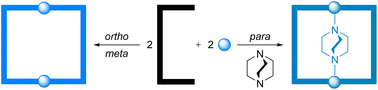
The coordination chemistry of Cu2+ with three isomeric xylylene-bridged bis-chelating pyridyltriazole ligands (o-xpt, m-xpt, and p-xpt) is systematically explored. These ligands were chosen for their ability to form trans-planar chelating coordination modes, in contrast to the commonly studied 2,2′-bipyridine analogs. The o-xpt and m-xpt ligands consistently form box-like binuclear complexes of the type [Cu2(xpt)2]4+, with square-pyramidal coordination geometries around the metal centers. For o-xpt, the Cu⋯Cu distance is approximately 4.1 Å, with intramolecular contacts of 3.4–3.8 Å between pyridyltriazole moieties that indicate π–π interactions. The m-xpt ligand forms more flexible [Cu2(m-xpt)2]4+ complexes with Cu⋯Cu distances ranging from 6.8 to 8.8 Å. In contrast, the p-xpt ligand produces a variety of structures, including 1-D coordination polymers, a triple-stranded helicate, or a polymeric network of macrocyclic dimers linked by additional p-xpt ligands, depending on the experimental conditions. Notably, 1,4-diazabicyclo[2.2.2]octane (dabco) functions as a templating agent to direct the assembly of a discrete binuclear complex, [Cu2(p-xpt)2(μ-dabco)]4+; [Cu2(p-xpt)2]4+ species could not be obtained in the absence of the template. Single-crystal X-ray analyses of representative complexes from all three ligand isomers reveal the structural diversity and influence of ligand topology on coordination geometries and supramolecular assemblies.
 Please wait while we load your content...


