


Hydroboration via metal-bound σ(B–H) bonds in Ru-(σ-borate) complexes: a pathway to η4-HBCC-σ,π-borataallyl complexes

Abstract
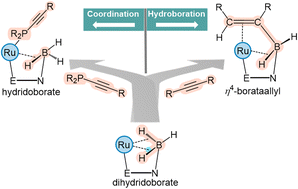
A series of hydroboration reactions involving terminal alkyne, internal alkyne, and alkynylphosphine using Ru-(σ-borate) complexes has been established. Initially, Cp*-based Ru-(σ-borate) complexes, [Cp*Ru(κ3-H,H,E-BH3LE)] (LE = C5H4NE, E = S, Se), denoted as 2E, were synthesized via a modified and efficient route. To assess the impact of secondary interaction mediated by heavier chalcogen atom, the reactions of 2Se with terminal alkyne were carried out, which resulted in the formation of η4-HBCC-σ,π-borataallyl complexes, [Cp*Ru(η4-HBCC-κ1-Se-BH2(CH![[double bond, length as m-dash]](https://www.rsc.org/images/entities/char_e001.gif) CHCO2Me)LSe)], 3a–b. To further examine the role of ancillary ligands in the hydroboration process, two distinct Ru-(σ-borate) complexes were selected, i.e., Ru-(σ-borate)(dihydridoborate), fac/mer-4, and Ru-bis(dihydridoborate), cis/trans-5. Treatment of fac/mer-4 with methyl propiolate yielded borataallyl complexes, fac/mer-[(κ3-H,S,S′-BH2(LS)2)Ru(η4-HBCC-κ1-S-BH2(CHCHCMeO2)LS)], 6a–b. The formation of complex 6 was attributed to the addition of the metal-bound σ(B–H) bond across the alkyne C
CHCO2Me)LSe)], 3a–b. To further examine the role of ancillary ligands in the hydroboration process, two distinct Ru-(σ-borate) complexes were selected, i.e., Ru-(σ-borate)(dihydridoborate), fac/mer-4, and Ru-bis(dihydridoborate), cis/trans-5. Treatment of fac/mer-4 with methyl propiolate yielded borataallyl complexes, fac/mer-[(κ3-H,S,S′-BH2(LS)2)Ru(η4-HBCC-κ1-S-BH2(CHCHCMeO2)LS)], 6a–b. The formation of complex 6 was attributed to the addition of the metal-bound σ(B–H) bond across the alkyne C![[triple bond, length as m-dash]](https://www.rsc.org/images/entities/char_e002.gif) C bond, followed by coordination of the resulting hydroborated olefin unit to the ruthenium centre. In contrast, prolonged thermolysis of fac/mer-4 with an internal alkyne, diphenylacetylene, led to the formation of thiolate-bridged bimetallic ruthenium complex, [(κ2-N,S-LS)Ru{(μ2-κ2-N,S-LS)(μ2-S-LS)}]2 (7). A notable structural feature of complex 7 is the presence of bidentate bridging ligands, observed in two tautomeric forms, i.e., pyridine-2-thiolate and pyridinyl-2-thione. Given that alkynylphosphine possess enhanced electron density at the alkynyl moiety and offer an additional coordination site through the phosphine group, the reaction of fac/mer-4 with Ph2P–CC–SiMe3 was subsequently performed. Interestingly, preferential coordination of the soft nucleophilic phosphine group occurred over hydroboration of the CC bond, resulting in the formation of a Ru-(σ-borate) complex, fac/mer-[(Ph2P–CC–SiMe3)Ru(κ3-H,S,S′-BH2(LS)2)(κ2-H,S-BH3LS)] (8). In an extension, the hydroboration of diphenylacetylene with cis/trans-5 yielded η4-HBCC-σ,π-borataallyl complexes, cis/trans-[(κ3-H,H,S-BH3LS)Ru(η4-HBCC-κ1-S-BH2(PhCCHPh)LS)] (9). In contrast, treatment of cis/trans-5 with an alkynylphosphine substrate led to the formation of mono (10) and bis (11) phosphine-coordinated σ-borate complexes. Density functional theory (DFT) calculations were conducted to assess the thermodynamic feasibility of these hydroboration pathways and to gain bonding insights into the resulting borataallyl complexes.
C bond, followed by coordination of the resulting hydroborated olefin unit to the ruthenium centre. In contrast, prolonged thermolysis of fac/mer-4 with an internal alkyne, diphenylacetylene, led to the formation of thiolate-bridged bimetallic ruthenium complex, [(κ2-N,S-LS)Ru{(μ2-κ2-N,S-LS)(μ2-S-LS)}]2 (7). A notable structural feature of complex 7 is the presence of bidentate bridging ligands, observed in two tautomeric forms, i.e., pyridine-2-thiolate and pyridinyl-2-thione. Given that alkynylphosphine possess enhanced electron density at the alkynyl moiety and offer an additional coordination site through the phosphine group, the reaction of fac/mer-4 with Ph2P–CC–SiMe3 was subsequently performed. Interestingly, preferential coordination of the soft nucleophilic phosphine group occurred over hydroboration of the CC bond, resulting in the formation of a Ru-(σ-borate) complex, fac/mer-[(Ph2P–CC–SiMe3)Ru(κ3-H,S,S′-BH2(LS)2)(κ2-H,S-BH3LS)] (8). In an extension, the hydroboration of diphenylacetylene with cis/trans-5 yielded η4-HBCC-σ,π-borataallyl complexes, cis/trans-[(κ3-H,H,S-BH3LS)Ru(η4-HBCC-κ1-S-BH2(PhCCHPh)LS)] (9). In contrast, treatment of cis/trans-5 with an alkynylphosphine substrate led to the formation of mono (10) and bis (11) phosphine-coordinated σ-borate complexes. Density functional theory (DFT) calculations were conducted to assess the thermodynamic feasibility of these hydroboration pathways and to gain bonding insights into the resulting borataallyl complexes.
 Please wait while we load your content...


