


pH-Induced fluorescence emission in chlortetracycline and signal amplification using MoS2 and WS2 quantum dots
 ab
Senthilkumar
Shanmugam,
*ab
Giribabu
Krishnan
*ab
and
Suresh
Chinnathambi
*ab
ab
Senthilkumar
Shanmugam,
*ab
Giribabu
Krishnan
*ab
and
Suresh
Chinnathambi
*ab
Abstract
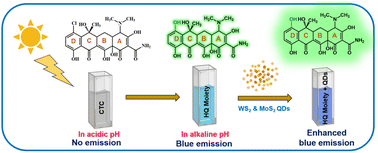
Rapid determination of chlortetracycline (CTC) in water and food products is essential to circumvent antibiotic-resistance related health issues. Herein, we synthesized WS2 and MoS2 quantum dots (QDs) by a simple hydrothermal approach and utilized them as a fluorescent probe to determine the unknown concentration of CTC present in various food and environmental samples. The fluorescence behaviour of pristine CTC has been systematically studied by altering the pH of the solution. Interestingly, a well-defined fluorescence response of CTC has been observed under alkaline conditions, while there is minimal fluorescence under acidic conditions. Analysis revealed that the formation of the hydroquinone (HQ) moiety via nucleophilic aromatic substitution causes fluorescence emergence under alkaline conditions. The UV-visible and 1H NMR spectra confirm the formation of the HQ moiety. Under the optimized conditions (pH 9), the fluorescence intensity of CTC linearly increased with increasing concentration, resulting in a limit of detection (LOD) of 60 nM. However, the integration of WS2 and MoS2 semiconducting quantum dots significantly improved detection limits, achieving LOD values of 0.035 μM and 0.019 μM, respectively. Interference studies specifically demonstrated that the developed materials exhibit the ability to detect CTC among other tetracycline compounds like oxytetracycline (OTC) and tetracycline (TC).
 Please wait while we load your content...


