


Grafting titanate nanotubes with 3-aminopropyltriethoxysilane for enhanced CO2 adsorption

Abstract
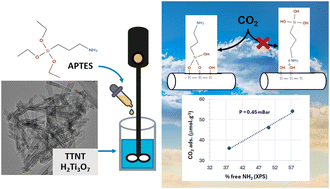
Amino-functionalized trititanate nanotubes (TTNTs) were prepared and evaluated for CO2 capture under conditions suitable for direct air capture (DAC) for the first time. 3-Aminopropyltriethoxysilane (APTES) was successfully grafted onto mesoporous TTNTs via a solution-phase method conducted in 95% ethanol at room temperature. Chemical analyses indicated that surface saturation was achieved at approximately 1.1 mmol of APTES per gram of grafted material. X-ray powder diffraction (XRPD), transmission electron microscopy coupled with energy-dispersive spectroscopy (TEM/EDS), and N2 sorption analyses confirmed the preservation of the nanotubular architecture and a homogeneous distribution of the grafted aminosilane species throughout the material. A concomitant reduction in the specific surface area and pore volume by 25–35% was observed. Systematic variation of the APTES concentration in the solution-phase method revealed a pronounced influence on the binding mechanism of the aminosilane molecules to the hydroxylated TTNT surface at the constant content of the grafted molecule. Elemental (CHN), thermogravimetric (TGA), Fourier-transform infrared (FTIR), and X-ray photoelectron spectroscopic (XPS) analyses verified the complete hydrolysis of APTES, yielding silanol groups that were involved in competing surface condensation pathways. The preferred configuration involved covalent Ti–O–Si bond formation, which preserves terminal –NH2 functionalities for CO2 chemisorption. These linkages were established either through direct condensation of silane triol species with surface Ti–OH groups (anchoring mode) or through partial self-condensation, leading to Si–O–Si crosslinking within an oligomeric or polymeric network (crosslinking mode). At very low pressures, approaching the partial pressure of CO2 in ambient air conducive to DAC, all functionalized samples exhibited significantly enhanced CO2 adsorption capacities compared with the pristine TTNT sorbent. A direct correlation was established between the CO2 chemisorption capacity and both the relative abundance of free –NH2 groups (quantified using XPS N 1s) and the degree of Si–O–Si polymerization (estimated using FTIR). The highest content of free –NH2 groups, corresponding to 57% of the total nitrogen present in the grafted materials, was achieved by adding 2.7 mmol g−1 APTES (2.5 times higher than the saturation content), leading to the best DAC capacity. The absolute CO2 chemisorption capacity of all grafted TTNT samples, measured under static conditions and below 0.1 mmol g−1, was lower than that typically reported for other solid sorbents, including APTES-modified oxides such as mesoporous alumina and silica. The present study provides a detailed understanding of the APTES grafting mechanism on TTNTs and establishes a direct correlation between the CO2 chemisorption capacity under DAC-relevant conditions and the nature of APTES grafting.
 Please wait while we load your content...


