


Correlating luminescence and single-molecule magnetism for two series of heteroleptic lanthanoid complexes
 a
Elena
Dallerba,
b
Massimiliano
Massi,
b
Christopher R.
Hall,
a
Marcus J.
Giansiracusa
*a
and
Colette
Boskovic
*a
a
Elena
Dallerba,
b
Massimiliano
Massi,
b
Christopher R.
Hall,
a
Marcus J.
Giansiracusa
*a
and
Colette
Boskovic
*a
Abstract
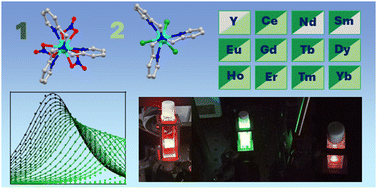
In the development of multifunctional materials, symmetry selection rules often exert opposing influences on luminescence and magnetic memory performance. For lanthanoid single-molecule magnets (SMMs), large crystal field splitting or high-symmetry environments are generally advantageous, as they suppress wavefunction mixing and minimize fast relaxation pathways—both essential for achieving slow magnetic relaxation. Conversely, these same selection rules often hinder luminescence in lanthanoid complexes, resulting in low quantum yields and frequently necessitating the use of the antenna effect, in which excitation occurs via a coordinating ligand. Here we report the subtle influence of ligand substitution in the related families of lanthanoid complexes: [Ln(tpa)(NO3)3] (1-Ln) and [Ln(tpa)Cl3] (2-Ln) (tpa = tris(2-pyridylmethyl)amine; Ln = Ce, Nd, Sm, Eu, Gd, Tb, Dy, Ho, Er, Tm, Yb). Despite the change in ligands, similar pseudo-symmetries are found for both 1-Ln and 2-Ln, yielding closest agreement to the C3 point group. In-field slow magnetic relaxation is observed for 1-Gd, 2-Gd, 2-Dy, 1-Yb and 2-Yb via ac magnetic susceptibility studies. Slower magnetic relaxation is found for 2-Gd and 2-Yb relative to their corresponding counterparts with computational studies validating larger crystal field splitting and increased ground state purity for 2-Yb and 2-Dy, consistent with the observed behaviour. Interestingly, the highly mixed ground state wavefunction for 1-Dy correlates with the absence of SMM behaviour, owing to the bidentate nature of the nitrato ligands, shifting ligand donor atoms away from the ideal axial position. The luminescence spectra for 1-Eu and 2-Eu both display splitting patterns of the 5D0 → 7FJ peaks consistent with a trigonal coordination environment. The luminescence decays indicate longer lifetimes for 1-Eu, which is ascribed to enhanced non-radiative decay for 2-Eu, following determination of similar radiative lifetime values for both complexes. This study highlights how subtle variations in lanthanoid coordination symmetry modulate both SMM and luminescence properties.
 Please wait while we load your content...


