


Cubic aromaticity in octahedral NbTcAu4 featuring a stable Nb–Tc quadruple bond plus four additional delocalized interactions

Abstract
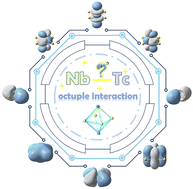
The formation of metal–metal (M–M′) multiple bonds facilitated by the partially filled d-orbitals and versatile valence electron configurations of transition metals underscores their distinct electronic regulatory capabilities. However, heteronuclear bimetallic systems encounter greater challenges in achieving stable multiple bonds than their homonuclear counterparts, primarily due to asymmetric valence orbital matching. Taking the sextuple-bonded Mo2 system as a reference, this research investigates a series of adjacent heteronuclear diatomic systems (Nb–Tc, Zr–Ru, and Y–Rh) stabilized by four equatorial s1-type electron-donor ligands (Au, Ag, and Cu) through theoretical methods. The implemented ligand-stabilization strategy significantly enhances intermetallic orbital overlap and bond order within the core, thereby yielding a series of all-metal clusters dominated by multiple bonds with substantial 5p-orbital contributions. Notably, the C4v-NbTcAu4 cluster is identified as the global minimum and features a formal Nb–Tc eight-fold orbital overlap. This multi-center interaction comprises a localized Nb–Tc quadruple bond supplemented by four additional delocalized interactions, yielding an effective bond order of 7.43 as determined using AdNDP analysis. Compared to the previously reported homo-D6h-Nb2Au6 with its octuple bond-like character, the heteronuclear C4v-NbTcAu4 exhibits a considerably enhanced 5p–5p orbital contribution. This introduces two additional π-bonding components that complement the six fundamental bonds derived from 4d and 5s orbitals. The resulting unique electronic configuration, further characterized by the cubic aromaticity characteristic, confers remarkable stability to the system.
 Please wait while we load your content...


