


Regioselective direct synthesis of mono- and bis-substituted benzimidazoles via base-switchable aerobic N-heterocyclic carbene organocatalysis
 a
Richa
Sharma,
b
Amol T.
Mahajan,
a
Abdul
Rahaman T. A.,
a
Samir T.
Sahu,
a
Alexander S.
Novikov
cd
and
Sandeep
Chaudhary
*a
a
Richa
Sharma,
b
Amol T.
Mahajan,
a
Abdul
Rahaman T. A.,
a
Samir T.
Sahu,
a
Alexander S.
Novikov
cd
and
Sandeep
Chaudhary
*a
Abstract
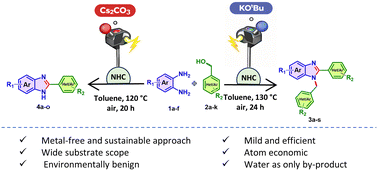
Herein, we disclosed a metal-free, highly efficient, and sustainable N-heterocyclic carbene-based organocatalyst utilized for the regioselective synthesis of mono- (4a–o) and bis-substituted benzimidazole (3a–s) derivatives under the optimized reaction conditions. The new catalytic protocol demonstrated high efficiency across a broad spectrum of substituted o-phenylenediamines (1a–f) and substituted benzyl alcohols (2a–k), and showed excellent tolerance towards various functional groups. The operationally developed protocol is quite simple, utilizes NHC as an organocatalyst, and furnishes the desired mono- (4a–o) and bis-substituted benzimidazole (3a–s) derivatives in up to 77% and 87% yields, respectively. While using NHC as an organocatalyst (catalyst C), bis-substituted benzimidazoles were obtained in the presence of a strong base (KOtBu), whereas mono-substituted benzimidazole was afforded using a weaker base (Cs2CO3). To gain deeper insight into the underlying mechanistic pathway, an array of control experiments has been performed. The mechanistic pathway involves in situ formation of aldehyde from the dehydrogenation of alcohol with the aid of NHC. Then, the resulting aldehyde condenses with diamine to generate imine, which, on further assistance with NHC, forms aza-Breslow intermediate, is converted into imidoyl azolium in aerobic conditions that subsequently undergoes cyclization to furnish benzimidazole. The mechanistic studies involved the detection of BHT-trapped ketyl adduct. Furthermore, EPR experiments suggested the possible involvement of free-radical species. Further, the synthetic utility of this protocol was demonstrated by gram-scale synthesis, intermolecular cyclization to 2-phenylquinazoline, and the synthesis of fungicide fuberidazole.
 Please wait while we load your content...


