


 PLATFORM UPDATE:


Controlling the electron–hole separation in photo-assisted C–C coupling reactions catalysed by a RuO2–ZnO heterojunction loaded with ultra trace palladium

Abstract
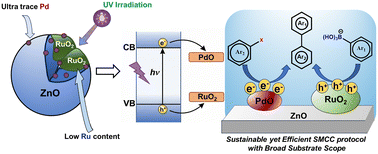
Zinc-oxide (ZnO) in combination with ruthenium-oxide (RuO2) appeared to be an effective light harvesting heterojunction, controlling the electron (e−) and hole (h+) recombination rate. An ultra-trace amount of palladium (Pd) loaded into this RuO2–ZnO hybrid heterojunction enabled a new, sustainable, cost-effective yet highly efficient non-free radical photocatalytic pathway for the Suzuki–Miyaura cross-coupling (SMCC) reaction, achieving superior selectivity and biaryl product yields over existing methods. Although research has aimed at improving photocatalysts' performance in SMCC, no study has yet been performed to understand such heterojunctions in the photocatalytic SMCC reaction. In the catalyst, ZnO retained its original role by absorbing UV-light, while RuO2, on the other hand, played a crucial role as a quasi-metallic co-catalyst favouring charge-carrier transportation. This cooperative charge-management strategy resulted in prolonged charge separation, enhanced redox-activity, and maximized the utilization of Pd centres. The reaction proceeded with 100% selectivity and provided excellent yields (up to 98%) within a very short reaction time of 70 min in a greener methanol/water (MeOH/H2O) solvent system. Some of the resulting SMCC keto-derivative products were reduced to synthesize a new range of important alcohol derivatives, further expanding the study. An in-depth kinetic study provided deeper insight into the reaction dynamics, while a systematic mechanistic analysis elucidated the charge carriers involved. Density functional theory (DFT) analysis was also performed to examine and compare the interactions involved in the photocatalysts. This work thus demonstrated a photostable, heterogeneous, recyclable, cost-effective, non-free radical and greener photocatalytic pathway for the SMCC reaction, highlighting the potential of multi-component semiconductor–metal architectures in the selective SMCC reaction with significantly low Pd loading.
 Please wait while we load your content...


