


Tailored N-heterocyclic perylene diimide polymers for photocatalysis via molecular engineering

Abstract
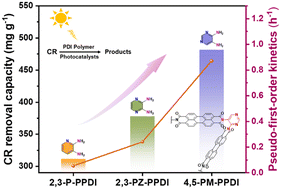
Synthetic control and rapid charge recombination have constrained the development of perylene diimide (PDI) polymer photocatalysts. This work presents a molecular engineering strategy employing twisted ortho-linked scaffolds and electron-withdrawing N-heterocycles to address these limitations. Three novel polymers, 2,3-P-PPDI, 4,5-PM-PPDI, and 2,3-PZ-PPDI, were synthesized, incorporating pyridine, pyrimidine, and pyrazine, respectively. The optimized 4,5-PM-PPDI exhibits a high molecular dipole, a lowered conduction band (CB) at −0.82 V, and an enhanced surface area of 19.42 m2 g−1, leading to outstanding photocatalytic activity. It achieves 96.29% degradation of Congo red (CR, 100 mg L−1) within 3 h, with a rate constant of 0.871 h−1 and a capacity of 481 mg g−1. Mechanistic investigations indicate that superoxide and hydroxyl radicals are the primary active species, generated via efficient charge separation. This study highlights the critical role of N-heterocycle selection in designing high-performance PDI polymeric photocatalysts for environmental applications.
 Please wait while we load your content...


