


Catalytic and mechanistic insights into desilicated ZSM-5 for crude oil-to-olefins conversion
 ab
Saheed A.
Ganiyu
*ab
ab
Saheed A.
Ganiyu
*ab
Abstract
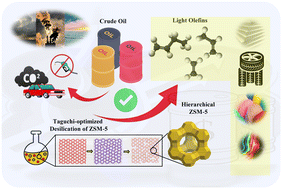
Meeting the growing demand for light olefins requires cost-effective, efficient production routes. Direct conversion of crude oil to light olefins offers a time- and cost-saving alternative to conventional multi-step processes. Herein, a hierarchical ZSM-5 zeolite with medium-to-large pores was synthesized via Taguchi design-assisted desilication, optimizing NaOH concentration, treatment time, and temperature. The optimized catalyst exhibited balanced micro-mesoporosity and moderate acidity, enabling enhanced diffusion and active site accessibility without loss of structural integrity. Optimization of desilication conditions results in a catalyst with optimum textural properties and moderate acid sites distribution, which, upon evaluation, exhibits a superior performance with conversion and selectivity towards light olefins of 65.23 and 15.6 wt% respectively at 550 °C, even though only 50% of the active catalyst was used in the catalyst bed. Comprehensive characterization (XRD, N2 sorption, NH3-TPD, TGA, FE-SEM, XRF, FTIR) confirmed the tailored textural and acidic properties, while in situ DRIFTS elucidated reaction pathways favoring olefin formation and coke precursor evolution. This work demonstrates that controlled desilication, guided by statistical optimization, can deliver hierarchical zeolites tailored for efficient, selective crude oil-to-olefin conversion.
- This article is part of the themed collection: Carbon for Catalysis
 Please wait while we load your content...


