


Catalytic and energy utilization increments in an atmospheric-pressure pulsed bipolar plasmatic–photocatalytic–thermocatalytic reaction due to different filling configurations of the photocatalyst

Abstract
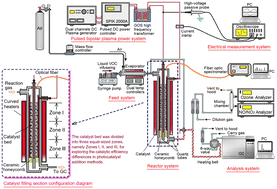
This study investigates the application of energy in the plasma-catalytic reaction of toluene, a process exhibiting combined plasmatic, photocatalytic, and thermocatalytic functionalities. Using an atmospheric pressure pulsed bipolar plasma device, we examined this reaction with toluene as the reactant, g-C3N4/mullite as the photocatalyst, and La0.7Sr0.3MnO3/mullite as the thermal catalyst. Experiments were conducted with different amounts and spatial distributions of the photocatalyst. The results indicate that the catalytic activity increases linearly with the amount of photocatalyst, particularly when the reactant conversion ranges from 50% to 80%. A competitive relationship was observed between photocatalysts and thermal catalysts for the organic reactants; consequently, photocatalytic efficiency significantly decreases as thermal catalysis becomes more effective at higher temperatures. The glow radiation intensity was found to be proportional to the toluene concentration. As toluene is consumed along the reaction bed, this glow intensity and the corresponding photocatalytic efficiency decrease axially. Therefore, strategically dispersing the photocatalyst is critical. Increasing the photocatalyst amount at the axial front end, where the reactant concentration is high, significantly enhances the catalytic increment by reducing catalyst competition. To quantify these effects, this study defines a synergy coefficient to assess the catalytic increment and determine theoretical conversion rates, and an energy utilization increment to evaluate energy efficiency, aiding in the identification of optimal reaction conditions.
 Please wait while we load your content...


