


 PLATFORM UPDATE:


Recent advances in cell-surface glycan engineering and its biological applications

Abstract
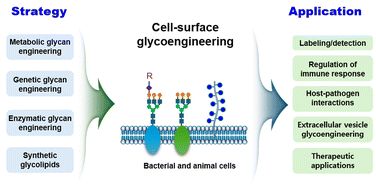
Cell-surface glycans, primarily present as glycoconjugates, play central roles in numerous physiological processes and pathological events. These glycans form a dense layer on the cell surface known as the glycocalyx, whose composition and organization vary across cell types and species. The structural and functional diversity of glycans has driven extensive efforts to manipulate the glycocalyx for both fundamental research and therapeutic applications. Over the past two decades, various approaches have been developed to modify cell-surface glycans, including metabolic glycan engineering, genetic glycan modifications, enzyme-mediated remodeling, and the incorporation of synthetic glycolipids. This review highlights significant advances since 2019 in cell-surface glycan engineering across mammalian and bacterial systems. We also discuss applications of glycan engineering in cell labeling and detection, modulation of biological processes, and biomedical research, emphasizing its growing importance in both basic and translational studies.
 Please wait while we load your content...


