


 PLATFORM UPDATE:


Machine-learning-assisted discovery of a stable Li3As2 intermediate phase in the Li–As binary system and its electrochemical implications
 *a
and
Haidi
Wang
*a
*a
and
Haidi
Wang
*a
Abstract
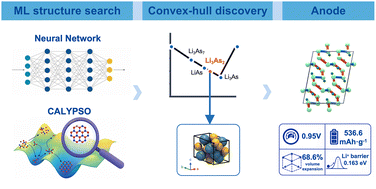
Alloy-type anodes offer high capacity, but deep lithiation usually causes severe volume expansion and structural instability. Identifying a thermodynamically stable intermediate phase with a moderate lithiation potential may offer a viable route to mitigating this dilemma. Here, we propose a hierarchical computational workflow that combines global structure search with a machine-learning interatomic potential to systematically explore phase evolution in the Li-rich region of the Li–As binary system. Fine-tuning a pretrained potential on a dataset of approximately 3500 configurations labeled by density functional theory (DFT) yields an energy root-mean-square error (RMSE) of 25.3 meV per atom on an independent test set. Structure screening with the fine-tuned potential, followed by DFT validation, reveals a thermodynamically stable intermediate phase, C2/c-Li3As2, lying on the convex hull between LiAs and Li3As. Phonon and electronic-structure calculations show that this phase is dynamically stable at 0 K and metallic. Electrochemical thermodynamic analysis indicates an equilibrium potential of about 0.95 V (vs. Li/Li+) for the LiAs ⇌ Li3As2 two-phase reaction. When lithiation is limited to Li3As2, the theoretical capacity reaches 536.6 mAh g−1 with a volume expansion of about 68.6%. Further climbing-image nudged elastic band (CI-NEB) calculations and molecular dynamics (MD) simulations show a low Li+ migration barrier. These results identify C2/c-Li3As2 as a promising intermediate phase for shallow-lithiation strategies and highlight its potential for fast-charging anodes.
 Please wait while we load your content...


