


 PLATFORM UPDATE:


Sensing the acidity of hydrogen bond networks
 *bc
and
Jahan M.
Dawlaty
*a
*bc
and
Jahan M.
Dawlaty
*a
Abstract
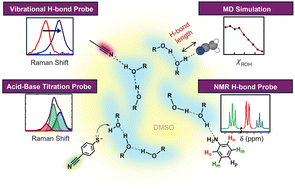
The reactivity of hydrogen bond networks (HBNs) is critical to many chemical and biological scenarios. When the HBNs are under constraint, hydrogen bond strength and acidity are affected significantly. HBNs exhibit cooperativity, where connections formed in one part of the HBN influence its behavior elsewhere. We combined experimental and computational approaches to examine the growth of the HBNs of water and hexafluoroisopropanol (HFIP), constrained by an aprotic cosolvent. We independently employed vibrational frequency shift of an acetonitrile probe, 1H NMR chemical shift of an aniline probe, and molecular dynamics with machine learning interatomic potentials, to demonstrate the increase in the hydrogen bond strength with the growth of the HBNs. Finally, using vibrational spectroscopy of a titratable probe, we established that not only the hydrogen bond strength, but also the acidity of HFIP is affected by the changes in the network geometry. These results enable the engineering and measurement of HBNs in confined environments with tailored acidity.
 Please wait while we load your content...


