


 PLATFORM UPDATE:


Atomistic mechanisms of guanidinium chloride passivation for suppressing ion migration and environmental degradation in MAPbI3 and FAPbI3 perovskites

Abstract
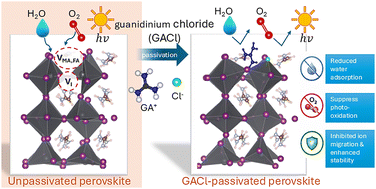
Hybrid organic–inorganic perovskite solar cells (PSCs) have achieved remarkable power conversion efficiencies; however, their operational stability remains limited by ion migration and environmental degradation induced by moisture and oxygen. Here, we employ first-principles density functional theory to elucidate the atomistic mechanisms by which guanidinium chloride (GACl) surface passivation enhances the stability of MAPbI3 and FAPbI3 perovskites. Surface defect analysis reveals that iodine vacancies promote lattice distortion, trap-state formation, and subsurface migration, particularly under illuminated conditions. A-site vacancies further reduce migration barriers, accelerating defect-assisted degradation. GACl passivation suppresses these processes through dual mechanisms: GA+ stabilizes A-site vacancies via hydrogen bonding with the inorganic framework, while the smaller and more electronegative Cl− strongly coordinates with undercoordinated Pb atoms at halide-vacancy sites and more effectively occupies confined interstitial spaces between the larger FA and GA organic cations. Nudged elastic band calculations show that GA incorporation substantially increases halide migration barriers, whereas Cl plays a secondary role. Environmental stability is further enhanced by reducing surface interactions with ambient O2 and H2O. Pristine surfaces exhibit strong H2O chemisorption and photoinduced O2 oxidation, producing reactive oxygen species and volatile degradation products. In contrast, GA passivation weakens water adsorption, suppresses proton transfer, and eliminates superoxide-induced trap states. Defect formation analysis confirms significant increases in vacancy formation energies for both A-site and halide defects after GACl treatment. These findings provide a comprehensive atomistic understanding of how GACl passivation simultaneously inhibits ion migration, moisture infiltration, and photooxidation, offering practical design principles for stabilizing high-performance perovskite solar cells.
 Please wait while we load your content...


