


 PLATFORM UPDATE:


Experimental and theoretical investigation of elastic electron scattering from halogenated anesthetic molecule desflurane

Abstract
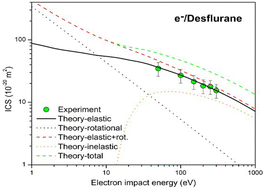
We present a comprehensive study of elastic electron scattering from desflurane (CHF2OCF2CHF2)(CHF2OCHFCF3) in the intermediate incident electron energy range of 50–300 eV. Desflurane is a widely used volatile inhalation anesthetic characterized by rapid onset and low metabolic transformation, but it also possesses one of the highest global warming potentials among commonly used anesthetics and a long atmospheric lifetime. These environmental concerns provide a strong motivation for investigating fundamental electron–molecule interaction processes involving this compound. The investigation was carried out through experimental measurements using a crossed electron–molecular beam apparatus over a broad angular range from 25° to 125°. Relative differential cross sections (DCSs) were measured and subsequently normalized to an absolute scale using the relative flow method with argon as the reference gas. The resulting angular distributions were extrapolated to the full angular range and integrated to obtain the corresponding integral cross sections (ICSs) and momentum-transfer cross sections (MTCSs). In parallel, theoretical calculations were performed within the Independent Atom Model combined with the screening corrected additivity rule including interference effects (IAM-SCAR + I). The calculated differential and integral cross sections show good overall agreement with the experimental results across the investigated energy range. To the best of our knowledge, the present work provides the first set of absolute differential cross sections for elastic electron scattering from desflurane, thereby extending the available database of electron–molecule scattering data for volatile anesthetics.
 Please wait while we load your content...


