


 PLATFORM UPDATE:


First-principles calculation study on large perpendicular magnetic anisotropy by interfacial modulation in the Fe/NiFe2O4 superlattice
 *a
*a
Abstract
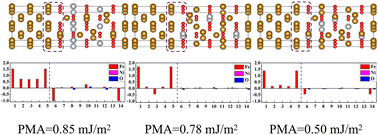
Magnetic random-access memory (MRAM) is emerging as a pivotal technology for next-generation non-volatile spintronics. At its core lies the magnetic tunnel junction (MTJ). With the advent of the era of artificial intelligence, MTJs are required to have large perpendicular magnetic anisotropy (PMA). Achieving strong PMA is the prerequisite for realizing MRAM devices with high integration density, low power consumption, and long-term data retention. Using first-principles calculations, we investigated the structure and magnetic anisotropy of the Fe/NiFe2O4 superlattice. It was found that all Fe/NiFe2O4 models exhibited PMA and the most energetically favorable configurations for Fe/NiFe2O4 interfaces occurred when the interface O atoms in NiFe2O4 were on top of the Fe atoms. Importantly, the Fe/NiFe2O4 heterostructure with the Fe–FeO interface showed an interfacial PMA density of up to 0.85 mJ m−2. Although the interface Fe3 atoms in NiFe2O4 make a relatively significant negative contribution to PMA, the interface Fe2 atoms in Fe produce a large PMA. The d-orbital-resolved magnetic anisotropy energy of interfacial Fe atoms revealed that, similar to surface Fe, the matrix element differences between the dz2 and dyz orbitals, as well as the dx2−y2 and dxy orbitals, make large contributions to the PMA. However, compared with the PMA of surface Fe, the energy difference between dxz and dyz for interfacial Fe provides a negative contribution to the PMA, making the PMA of interfacial Fe lower than that of surface Fe. A density of state analysis revealed that the bonding between the Fe and O atoms arises from the increase in the hybridization between the relevant spin orbitals. Our results indicate that the Fe/NiFe2O4 heterostructures are promising candidates for achieving large PMA in MTJs.
 Please wait while we load your content...


