


 PLATFORM UPDATE:


A systematic study of Prussian blue analogs as cathode materials for calcium ion batteries and interstitial water regulation: first-principles calculations
 *ab
and
Yuanyuan
Pan
*a
*ab
and
Yuanyuan
Pan
*a
Abstract
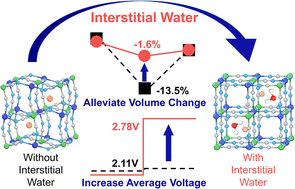
Prussian blue analogs (PBAs), known for their open three-dimensional framework and adjustable redox activity, have emerged as promising cathode materials for multivalent ion batteries. This study provides theoretical insights into CaxMFe(CN)6 (M = Mn, Fe, and Co) as cathode materials of calcium ion batteries (CIBs), elucidating the regulatory mechanism of the interstitial water through first-principles calculations. CaxMnFe(CN)6 and CaxFeFe(CN)6 undergo significant structural distortion and substantial volume changes during the charging process, which can be effectively alleviated by the insertion of the interstitial water, whereas CaxCoFe(CN)6 maintains a relatively stable structure. Furthermore, the low average voltage of CaxMFe(CN)6 can be increased by incorporating the interstitial water. Surprisingly, the diffusion barriers of Ca2+ are extremely low (0.24–0.31 eV) in PBAs, which directly accounts for their superior kinetic performance. It is revealed that there is a sequential redox mechanism with M2+/M3+ first, and then low-spin Fe2+/Fe3+ during the decalcification in CaxMFe(CN)6. This study not only explores the electrochemical performance of PBAs for CIBs, but also establishes a theoretical foundation for designing high-performance CIBs through the interstitial water.
 Please wait while we load your content...


