Spectroscopic characterization of UV-induced efficient CO2 binding via non-covalent N···C interactions in N-containing PAH molecules

Abstract

This study investigates the molecular-level CO2 binding of nitrogen-containing aromatic hydrocarbons, specifically 7-azaindole (7AI) and 2,7-diazaindole (27DAI). Using resonant two-photon ionization (R2PI), UV-UV hole-burning, and ion-dip infrared (IDIR) spectroscopy, we identified non-covalently bound molecular complexes, 7AI·CO2 and 27DAI·(1,2)CO2, formed in a supersonic molecular beam. The experimental results, supported by quantum chemical calculations, revealed that CO2 binding in a 1 : 1 complex is facilitated by N⋯C non-covalent interactions and a weak N–H⋯O hydrogen bond interaction. The 27DAI·2CO2 complex showed simultaneous binding of CO2 at two different binding sites, while the mode of each CO2 binding is aided by N⋯C and N–H⋯O interactions. The study highlights how nitrogen insertion into the aromatic framework and UV excitation significantly enhance CO2 binding interactions, providing insights for designing next-generation CO2 capture materials.
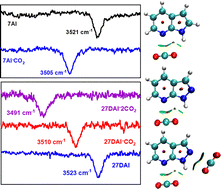
Graphical abstract: Spectroscopic characterization of UV-induced efficient CO2 binding via non-covalent N···C interactions in N-containing PAH molecules

Transparent peer review

To support increased transparency, we offer authors the option to publish the peer review history alongside their article.

View this article’s peer review history

Article information

Article type
Paper
Submitted
23 Mar 2026
Accepted
16 May 2026
First published
02 Jun 2026

Phys. Chem. Chem. Phys., 2026, Advance Article

Spectroscopic characterization of UV-induced efficient CO2 binding via non-covalent N···C interactions in N-containing PAH molecules

S. B. Panda, B. Kalal, S. Gharai and S. Maity, Phys. Chem. Chem. Phys., 2026, Advance Article , DOI: 10.1039/D6CP01058J

To request permission to reproduce material from this article, please go to the Copyright Clearance Center request page.

If you are an author contributing to an RSC publication, you do not need to request permission provided correct acknowledgement is given.

If you are the author of this article, you do not need to request permission to reproduce figures and diagrams provided correct acknowledgement is given. If you want to reproduce the whole article in a third-party publication (excluding your thesis/dissertation for which permission is not required) please go to the Copyright Clearance Center request page.

Read more about how to correctly acknowledge RSC content.

Social activity

Spotlight

Advertisements