


 PLATFORM UPDATE:


Interfacial microdroplets reshape the oxidation pathways of polycyclic aromatic hydrocarbons

Abstract
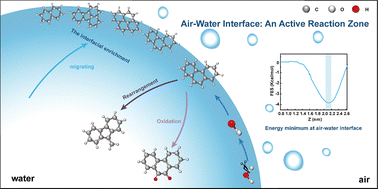
Aromatic molecules are ubiquitous in chemistry and materials science, yet their reaction chemistry at air–water interfaces remains poorly understood. Here, we report that PAHs composed of multiple fused aromatic rings undergo spontaneous and efficient degradation in microdroplets produced by ultrasonic atomization. Up to 95% degradation of the tested PAHs (naphthalene, phenanthrene, pyrene, and fluoranthene) was achieved after 20 minutes of reaction at the microdroplet interface. Mechanistic investigation showed that the interfacial enrichment of hydrophobic molecules, together with reactive oxygen species generated under interfacial electric fields, synergistically drives the rapid transformation of PAHs in microdroplets. Product analysis and density functional theory (DFT) calculations further revealed that, in addition to a conventional ˙OH oxidation pathway, the air–water interface may promote a carbocation-mediated aromatic SN1-type skeletal rearrangement, yielding fluorene-type rearrangement products. More importantly, microdroplet-based oxidation has limited ability to fully mineralize PAHs but instead promotes the accumulation of characteristic intermediates (such as hydroxylation and rearrangement products). This study reveals a previously unrecognized interfacial oxidation pathway of phenanthrene, providing new insights into the interfacial reaction chemistry of aromatic molecules.
 Please wait while we load your content...


