


 PLATFORM UPDATE:


Atomic-scale study of the influence of grain boundary defects in polycrystalline oxide solid-state electrolytes on Li-ion conductivity
 *ab
*ab
Abstract
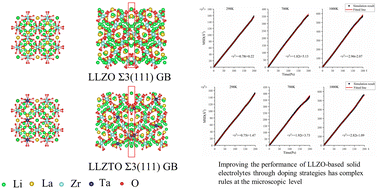
The development of high-performance solid-state electrolytes (SSE) is fundamental for the application of all-solid-state lithium metal batteries. Polycrystalline oxide SSEs have received widespread attention due to their good compatibility with lithium metal. However, the garnet-type Li7La3Zr2O12 (LLZO) SSE, a typical representative of oxide SSEs, still faces problems such as dendrite growth. To gain a comprehensive understanding of how the microstructure of LLZO-based solid-state electrolytes (SSEs) affects lithium deposition and dendrite growth, the LLZO SSE was doped and modified. The influence of its microstructure on Li-ion conductivity was further studied at the atomic scale through molecular dynamics simulations. The results show that the improvement of the performance of LLZO-based SSEs through doping strategies involves complex mechanisms at the microscopic level. A simplified polycrystalline model was developed based on the calculated conductivity, explicitly considering the influence of polycrystalline material microstructure on the material properties by combining the contributions of bulk phase and grain boundary (GB) conductivity. The results show that elemental doping has a non-monotonic effect on the material microstructure. Controlling the microstructure of solid electrolytes is of great significance to the development of polycrystalline SSE materials and provides theoretical guidance for the design of high-performance SSEs.
 Please wait while we load your content...


