


 PLATFORM UPDATE:


Strain modulated hydrogen storage aspects and optoelectronic and thermoelectric energy harvesting in newly synthesized BaSiH6
 *a
*a
Abstract
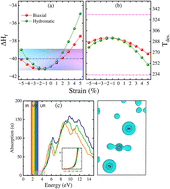
Hydrogen is widely acknowledged as a highly effective potential solution to meet the steadily increasing demand for clean and environmentally friendly energy, where hydridosilicates emerge as an efficient hydrogen storage (HS) material. Therefore, BaSiH6 (BSH) is examined through first-principles calculations to assess its HS potential under strain. The calculated formation enthalpy (ΔHf) of −40.86 kJ per mol H2 for the unstrained (unstr.) system aligns excellently with the ideal value of −40 kJ per mol H2, while varying between −42 and −35 kJ per mol H2 under ±5% biaxial/hydrostatic strain. The calculated hydrogen desorption temperature (Tdes.) of 292 K (unstr. value) and strained values fall within the excellent range of 233–333 K. Besides, a gravimetric HS capacity of 3.53 wt% is achieved, and the volumetric HS capacity of 57.91 g H2 per L (unstr.) increases to 64.17 and 67.54 g H2 per L under −5% biaxial and hydrostatic strains, respectively. Moreover, ab initio molecular dynamics simulations confirm the thermal stability of the system at 300 K, as no spontaneous decomposition was observed. Additionally, all the structures are mechanically stable and exhibit ductile behavior. The ionic bonding in the structure is supported by electron density analysis, which reveals predominantly ionic Ba–H and covalent Si–H character. Interestingly, systems exhibit suitable energy gaps and substantial visible-light absorption, which enhances their potential for efficient solar energy conversion. Significant optical absorption is evident in the visible region, while the ultraviolet region shows high absorption coefficients of 154/149/142 × 104 cm−1 and 169/149/133 × 104 cm−1 across −5%/0%/+5% biaxial and hydrostatic strains, respectively. Interestingly, the system displays a high Seebeck coefficient and figure of merit of 0.68/0.69/0.76 and 0.69/0.69/0.74 at 800 K under the −5%/0%/+5% biax. and hydro. strain levels. Hence, the present study suggests the strong potential of BSH for HS, optoelectronic, and energy harvesting applications.
 Please wait while we load your content...


