


 PLATFORM UPDATE:


Neural-network deep potential models for lithium adsorption on C–N–O-modified carbon materials
 *a
and
*a
and
Abstract
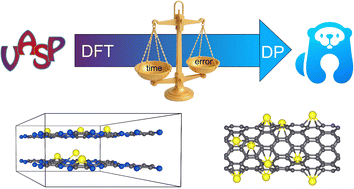
Machine-learned interatomic potentials are developed for C–N–O–Li systems that are relevant to lithium-ion battery anode materials. The training database has been constructed from calculations derived from spin-polarized density functional theory, incorporating dispersion interactions. It encompasses a broad spectrum of carbon nanostructures, in addition to nitrogen-containing (C2N) and oxygen-containing (tetraoxa[8]circulene) models that interact with adsorbed lithium atoms. Within the Deep Potential framework, five interatomic potentials were constructed and systematically analysed, including a model based on a two-body (se_e2_a) descriptor and attention-based architectures (DPA-2 and DPA-3), trained both from scratch and via fine-tuning of pretrained universal models. The accuracy of the developed potentials is assessed in terms of energy and force errors, reproduction of equilibrium geometries, elastic properties, and lithium adsorption energies. The DPA-based models have been shown to consistently outperform the two-body descriptor potential, with the best agreement with DFT reference data being achieved by fine-tuned attention-based models. The validation results demonstrate reliable reproduction of equilibrium structures, elastic properties of two-dimensional carbon materials and carbon nanotubes, as well as lithium adsorption energetics on pristine and heteroatom-modified carbon surfaces. In conclusion, the proposed machine learning potentials offer an accurate and computationally efficient framework for modelling the structural, mechanical and adsorption properties of advanced carbon-based anode materials.
 Please wait while we load your content...


