


The structural stability and temperature-dependent exciton dynamics of CsPbBr3 millimeter crystals
 *a
Jia
Liu,
a
*a
Jia
Liu,
a
Abstract
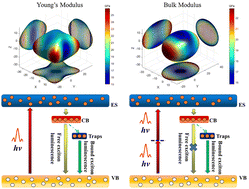
Understanding the intrinsic lattice properties and exciton dynamics of halide perovskites is crucial for the rational optimization of their optoelectronic performance. Here, density functional theory (DFT) calculations reveal that CsPbBr3 exhibits no imaginary phonon modes, confirming its dynamical stability. The calculated Pugh's ratio (2.47) and Poisson's ratio (0.32) indicate pronounced ductility, suggesting a soft lattice favorable for electron–phonon coupling. To experimentally probe the intrinsic optical response free from surface and size effects, CsPbBr3 millimeter crystals were successfully synthesized via an anti-solvent vapor-assisted crystallization method. Under single-photon excitation, dual emission peaks at 525 and 555 nm are observed, attributed to free exciton (FE) and bound exciton (BE) recombination, respectively. Under two-photon excitation, only BE emission remains due to reabsorption of higher-energy FE emission. As the temperature increases, the photoluminescence intensity decreases and the emission spectrum broadens due to enhanced nonradiative recombination. Under femtosecond excitation, the lifetime is 1.61 ns, indicating carrier-induced activation of bulk defects. These results elucidate the exciton recombination dynamics and electron–phonon interaction mechanisms in bulk CsPbBr3, highlighting its potential for optoelectronic and photovoltaic applications based on fully inorganic halide perovskites.
 Please wait while we load your content...


